


 Try this out at nearest store


 Get directions
 Call our store
Trusted by Indian Society of Sleep Research to enhance N3 sleep
Your cart (0)
Your cart (0)
To ensure a smooth delivery and perfect fit, please confirm the following:


Hamper value varies by mattress size

₹8,000 on orders above ₹2L · ₹15,000 above ₹2.5L · ₹30,000 above ₹3L
See where to experience the product & when it arrives
Download the Airboost brochure to explore the technology, benefits, features and mattress range.
Get the complete Airboost catalogue
Your download has started. Add your details.




Trusted by Indian Society of Sleep Research to enhance N3 sleep

Exclusively approved by doctors at NHA

German certified
Arctic ice fabric is a specialized cooling material used in the mattress cover. It promotes airflow and keeps you fresh throughout the night.
The mattress offers a medium firm feel, which provides balanced support and comfort. It's ideal for most sleepers, offering enough support for proper spinal alignment while still contouring to relieve pressure points.
This Airboost mattress is specifically engineered to solve the "heat trap" issue common in traditional foam mattresses. By combining breathable Pinhole Neo Latex with our proprietary Airboost layer, it ensures a much cooler sleep surface.
Yes. This Airboost mattresses comes with a 100 day sleep trial period that allows you to experience the mattress at home before making a final decision
Recognized By

The Duroflex Airboost delivers on its promises in a way that feels convincing and real from the very first night.

The Airboost wins clearly on temperature regulation and loses nothing on support. A revolution in the making from Duroflex.

Most comfortable mattress I’ve personally used. Duroflex’s Airboost hands down the best mattress in 2026.

Managing Partner, Enormous Brands
Managing Partner, Enormous Brands

CEO, DAIOM
CEO, DAIOM

Marketing Manager, Diageo
Marketing Manager, Diageo

Marketing Head, Subway
Marketing Head, Subway

Professor, IIM Mumbai
Professor, IIM Mumbai
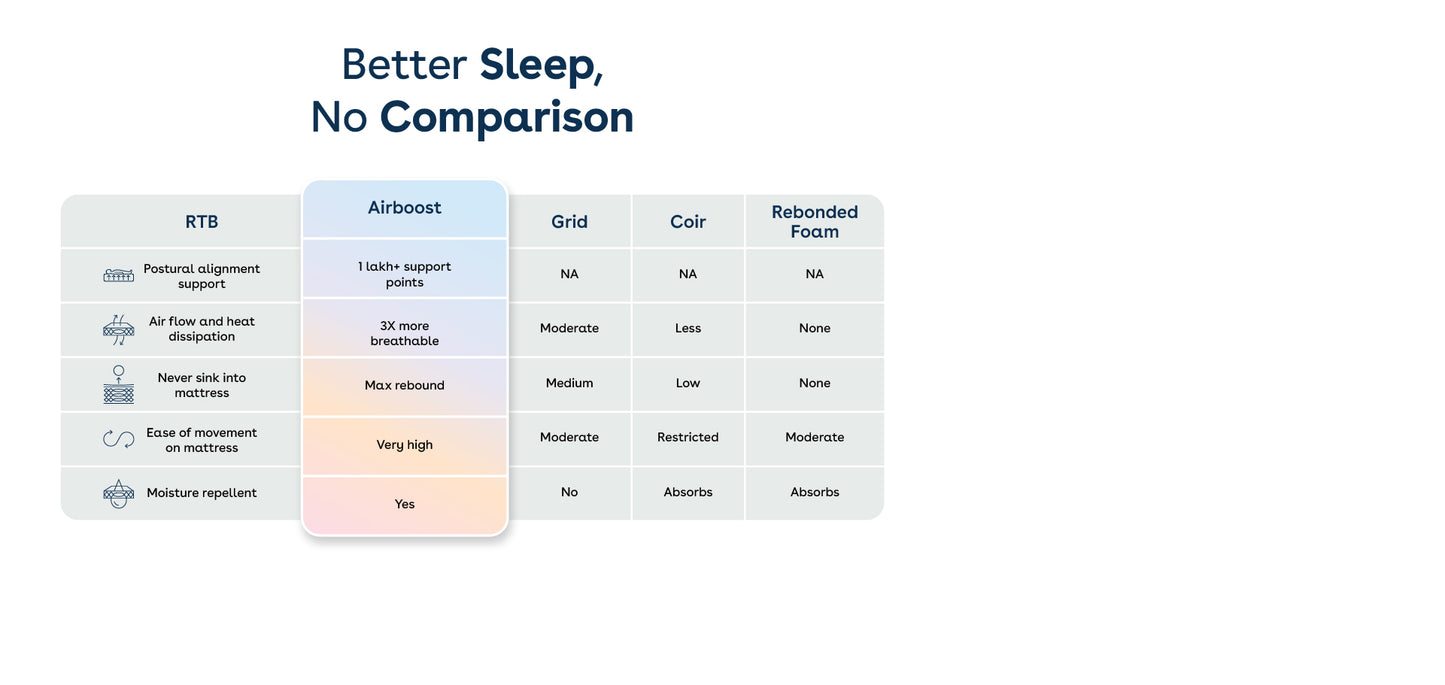
 Postural Alignment
 Airflow and heat dissipation
 Never sink-in
 Ease of movement
 Moisture repellent
Airboost is a mattress technology that uses an adaptive air-filament structure to provide stable support, improved airflow, and easier movement during sleep.
Instead of behaving like a solid block, Airboost distributes body weight across thousands of micro-support points while allowing air to flow through the mattress core. This helps manage pressure, heat, and movement throughout the night.
Airboost feels more breathable and stable than memory foam, which typically sinks and retains heat.
Memory foam softens with body heat and responds slowly, which can trap warmth and create a stuck feeling. Airboost responds instantly to pressure and movement, distributes load without collapse, and allows continuous airflow through its structure.
Hot sleepers often experience discomfort because heat and moisture get trapped under the body.
Airboost allows heat and moisture to dissipate through airflow, while memory foam tends to trap warmth due to its dense structure.
Night-time sweating is often caused by trapped heat rather than room temperature alone.
Airboost’s open air-filament structure supports heat and moisture dissipation through the mattress core, helping maintain a more stable sleep surface.
Bounce feels springy and transfers movement, while rebound restores shape smoothly without disturbing the surface.
Spring mattresses store and release energy across the entire mattress, which can cause motion transfer. Airboost provides localized rebound where only the compressed area recovers, helping maintain surface stability.
Yes. Airboost helps reduce motion transfer compared to bouncy mattress systems.
Because Airboost rebounds locally instead of across the mattress, movement does not travel far. This helps limit disturbances when a partner changes position.
Yes. Airboost cushions pressure at the shoulders and hips while supporting the waist.
Side sleeping concentrates body weight at specific points. Airboost adapts locally to heavier areas while maintaining support in lighter zones, helping keep the spine aligned.
Yes. Airboost helps maintain natural spinal alignment for back sleepers.
Back sleepers need balanced support that prevents hip sink while supporting the lower back. Airboost distributes load evenly and adapts to body shape.
Yes. Airboost provides stable support that helps prevent excessive hip sink.
Yes. Airboost supports easier movement without feeling stuck.
Materials with slow recovery can increase effort during movement. Airboost responds instantly, reducing the effort needed to change positions and re-settle.
Yes. Airboost is designed to support higher body weight without deep sagging.
Higher body weight increases pressure concentration. Airboost distributes load across thousands of filaments, improving stability, mobility, and long-term shape integrity.
Airboost adapts continuously, while grid mattresses rely on fixed geometric cells.
Grid designs compress at defined points based on geometry. Airboost uses independent filaments that respond fluidly to body weight, creating smoother pressure distribution and stable support.
Rebonded foam relies on density and can create pressure hotspots. Airboost supports firmness through structure while adapting to the body and allowing airflow.
Coir mattresses are firm but not adaptive, while Airboost balances support, comfort, and breathability.
Airboost supports alignment and pressure distribution, which can improve sleep comfort.
Back discomfort during sleep often arises from misalignment and pressure buildup. Airboost helps maintain neutral posture by preventing collapse in heavy zones.
Most people adjust within a few weeks of regular use.
Any change in sleep surface can require an adaptation period as posture and muscle memory adjust. Airboost does not rely on break-in softening, but the body may still need time to adapt.
No. Airboost is not inflatable and does not feel like an air bed. It uses air as part of a fixed structural matrix, not adjustable air chambers.
Surface fabrics influence first touch. Long-term thermal comfort comes from airflow through the Airboost layer.
Greater Airboost layer thickness supports stronger load handling. Cooling fabrics and latex layers influence feel and premium positioning. Refer to the SKU table for final selection.
Yes. Some Airboost mattresses come with a 100-day sleep trial period that allows you to experience the mattress at home before making a final decision.
Airboost mattresses come with a long-term manufacturer warranty that covers manufacturing defects and material issues under normal use conditions. Warranty duration varies from 7-10 years depending on the variant.
Duroflex Airboost mattresses are available online at Duroflex’s official website and at select Duroflex brand stores and partner retail outlets across India.
To find the nearest Duroflex experience centre near you click here.
Compared to traditional foam, spring, coir, or rebonded mattresses, Airboost focuses on airflow, adaptive support, and movement stability rather than density or bounce. This makes it especially suitable for Indian sleeping conditions where heat and humidity affect sleep quality.
Duroflex Airboost mattresses are available across multiple price points depending on thickness, construction, and fabric options. Entry variants start from Rs. 23,000 while premium Arctic Ice and latex-combination variants are priced higher.
Some Airboost models offer dual-comfort or reversible configurations that allow you to choose between two firmness feels. Full firmness customisation is not adjustable on demand but is offered through model selection.
Traditional gaddas offer firmness but lack adaptive support and airflow. Airboost provides structured support, pressure distribution, and breathability, making it better suited for modern sleep needs and longer sleep durations.
Arctic Ice is a cooling fabric used on select Airboost models. It provides a cooler-to-touch feel and works with the AriKnit and Airboost core to support better heat dissipation during sleep.
Airboost improves sleep quality by supporting thermoneutral sleep, reducing pressure buildup, and making movement easier during the night.
Peer-reviewed sleep research published in PLOS One has shown that high-rebound sleep surfaces can support deeper sleep stages, reduced muscle effort during movement, and better body temperature regulation. Airboost is designed around similar rebound and stability principles.
Lower back pressure at night often comes from poor alignment or excessive sinking at the hips. Airboost uses an adaptive air-filament structure that distributes body weight across thousands of micro-support points. Heavier areas like the hips receive more support, while lighter areas like the lower back remain gently supported. This helps maintain a more neutral spine position and reduces pressure stress through the night.
Thermoneutral sleep refers to the temperature range in which the body does not need to work to cool down or warm up during sleep.
Airboost uses an adaptive air-filament structure that creates continuous airflow pathways through the mattress core. This allows excess heat and moisture to move away from the body, helping the sleep surface stabilise within the thermoneutral zone.
By reducing thermal stress, Airboost helps the body stay comfortable for longer periods, supporting deeper and more uninterrupted sleep without relying solely on surface cooling fabrics.
N3 sleep, also known as deep sleep, is the deepest stage of non-REM sleepand is responsible for physical recovery, tissue repair, and energy restoration.During this stage, heart rate and breathing slow down, muscles relax fully, and the body focuses on physical repair and recovery. This stage is sensitive to disturbances caused by pressure discomfort, excessive movement, and overheating.
AirBoost uses an adaptive air-filament structure that distributes body weight evenly, reducing pressure buildup that can cause micro-awakenings. Its controlled rebound provides surface stability, making it easier to change positions without fully waking up. In addition, the open structure supports airflow, helping the body stay within a thermoneutral range. Together, these factors help reduce sleep interruptions, creating conditions that are more supportive of sustained N3 deep sleep.
The Duroflex Airboost 3.8 Bionix Ice Pro offers the same adaptive support as Airboost 3.10, featuring 1 lakh+ Airknit fibres, a neo-latex layer, a 3-zone pocket spring layer, and is Airboost Lite with Arctic Ice cooling fabric, but in a slimmer 8-inch profile. It is a great choice for those who prefer a lower mattress height while still enjoying excellent pressure relief, breathability, and spinal support for obtaining deep sleep.
The Duroflex Airboost 3.8 Bionix Ice Pro is a strong match for light to average-build sleepers who deal with heat and back discomfort during sleep and want both of those addressed in a single medium-firm mattress. Airboost 3.8 Bionix Ice Pro is a practical everyday choice that combines pressure relief, breathability, and energy restoration for consistent deep sleep comfort.
The Duroflex Airboost 3.8 Bionix Ice Pro is designed for hot sleepers, as it features Arctic Ice cooling fabric and an open-cell 3D matrix core that helps dissipate heat and sweat efficiently. The mattress is 3X more breathable than traditional mattresses, promoting continuous airflow for a cooler and more comfortable sleep throughout the night. Airboost is exclusively accredited by ISSR for 30% for deep sleep and recommended by doctors at NHA.
Unlike a standard firm mattress that provides uniform support across the body, the Duroflex Airboost 3.8 Bionix Ice Pro uses Hyperlocal Ortho Support with 1 lakh+ Airknit fibres that respond independently to different pressure points. This delivers adaptive support to heavier areas like the shoulders and hips while maintaining proper spinal alignment and balanced comfort throughout the night.



Sign up to get early access, limited drops & insider updates.


Someone sent you